I Wasn’t Trying to Avoid the Vet. I Was Afraid of Making the Wrong Decision for My Senior Dog.
The conversation that finally separated “needs professional care” from “may be managed carefully on a visible surface between visits.”

Older dogs still need an individual veterinary assessment. A home device and professional care solve different jobs.
At twelve, Rosie had mastered the art of making every ordinary day feel important.
She waited by the kettle in the morning. She knew which cupboard held the chicken treats. She still trotted to the door when I picked up her lead, just a little more slowly than before.
Then I noticed a hard yellow-brown ridge on one of her back teeth.
I did what anxious owners do. I searched. I read dramatic posts. I found stories that made professional dental care sound routine and other stories that made every decision sound terrifying.
By midnight I had not become more informed. I had simply collected more ways to worry.
I was not looking for a page that told me to avoid the veterinarian. I wanted someone to explain what professional care does, what I could responsibly do at home and where the line between them actually sits.
The estimate was not the problem
The clinic could not give me a meaningful final number before evaluating Rosie because the total depended on her examination, bloodwork, imaging, anesthesia plan and whether any teeth needed treatment or extraction.
That uncertainty felt frustrating, but it was not dishonesty. It was the reality that two older dogs with similar-looking mouths can need very different care.
What I needed was not a guaranteed number. I needed a decision tree.
The veterinary conversation that changed the question
The veterinarian did not tell me that age alone made dental care impossible. She explained that Rosie’s individual health, exam and diagnostics mattered more than a blanket rule about senior dogs.
She also drew a firm line: an at-home device cannot assess the tooth root, clean below the gumline, diagnose infection, provide dental X-rays or treat a loose or damaged tooth.
But visible hard material on a stable outer surface is a different job from everything happening beneath the gumline. If the tooth was suitable and Rosie tolerated handling, careful between-visit surface care could be discussed as part of—not a replacement for—her plan.
I had been asking one tool to answer every question
I wanted the veterinarian to solve prevention, surface appearance, diagnosis and long-term maintenance in one sentence. I wanted a home product to remove uncertainty. Neither expectation was realistic.
Professional care answers the diagnostic and treatment questions. Brushing helps control soft plaque. A controlled home device has a narrower possible role on suitable visible hard tooth surfaces.
Call the veterinarian promptly
Loose or cracked teeth, bleeding, swelling, obvious pain, refusal to eat, sudden behavior change, facial swelling, pus, wounds or severe gum inflammation.
Discuss between-visit surface care
A stable tooth, visible outer-surface buildup, no pain response, no bleeding and a dog that can accept brief careful mouth handling.

The questions I brought back to the clinic
I stopped asking, “Is home cleaning good or bad?” and asked narrower questions instead. Does this tooth appear stable? Is the visible material limited to the outer surface? Is there gum inflammation or a pain response? What signs would mean I stop immediately? What professional work does Rosie still need even if the visible surface looks cleaner?
Those questions produced a much clearer conversation than trying to obtain a universal yes or no from an internet photograph.
The quiet tool I researched next
RodentLab is a rechargeable ultrasonic dog dental cleaner with five adjustable levels, an LED work light and a soft-tissue sensor. It is designed for visible surface tartar. It does not claim to reach below the gumline or replace a veterinary examination.

RodentLab™
Starter $99.90 · Full Kit $129.90 · 60-day results-based guarantee.
Review the product and limitsI expected Rosie to hate it
She had never enjoyed having her mouth handled. So I did not begin with the metal tip near a tooth.
On the first day I showed her the switched-off device with the transparent cap on. She sniffed it, took a treat and went back to her bed. That was the entire session.
On the second day I touched her cheek, lifted the lip for a moment and stopped. On another day I turned the device on across the room, then switched it off before approaching her.
When we finally tried one tooth, I removed the clear storage cap and placed it on the table. I selected the lowest level. The LED showed the outer surface clearly.
I made brief contact, gave Rosie her reward and ended the session before she pulled away.
The important result that day was not a dramatic before-and-after. It was that she came back when I picked up another treat.
Then the hard edge began to move
Over several short sessions, the edge of a visible deposit changed. A small hardened piece released from the surface. I photographed the tooth in the same light rather than convincing myself the whole mouth was “fixed.”
That result had limits. It did not tell me what was happening below the gumline. It did not cancel Rosie’s professional plan. It did not mean every tooth was appropriate for home care.
It did give me one controlled maintenance step I could repeat without turning dental care into a frightening event for either of us.
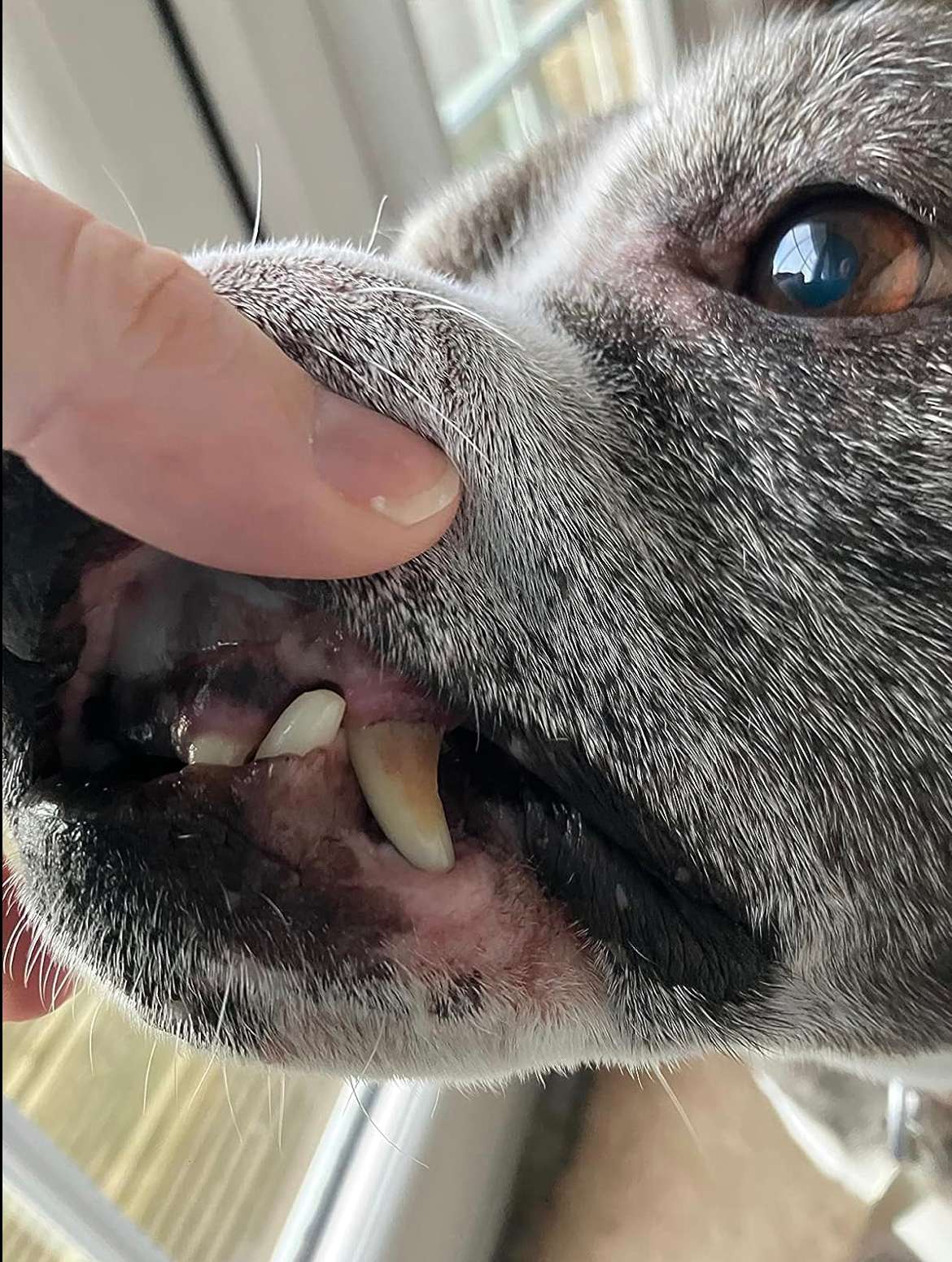
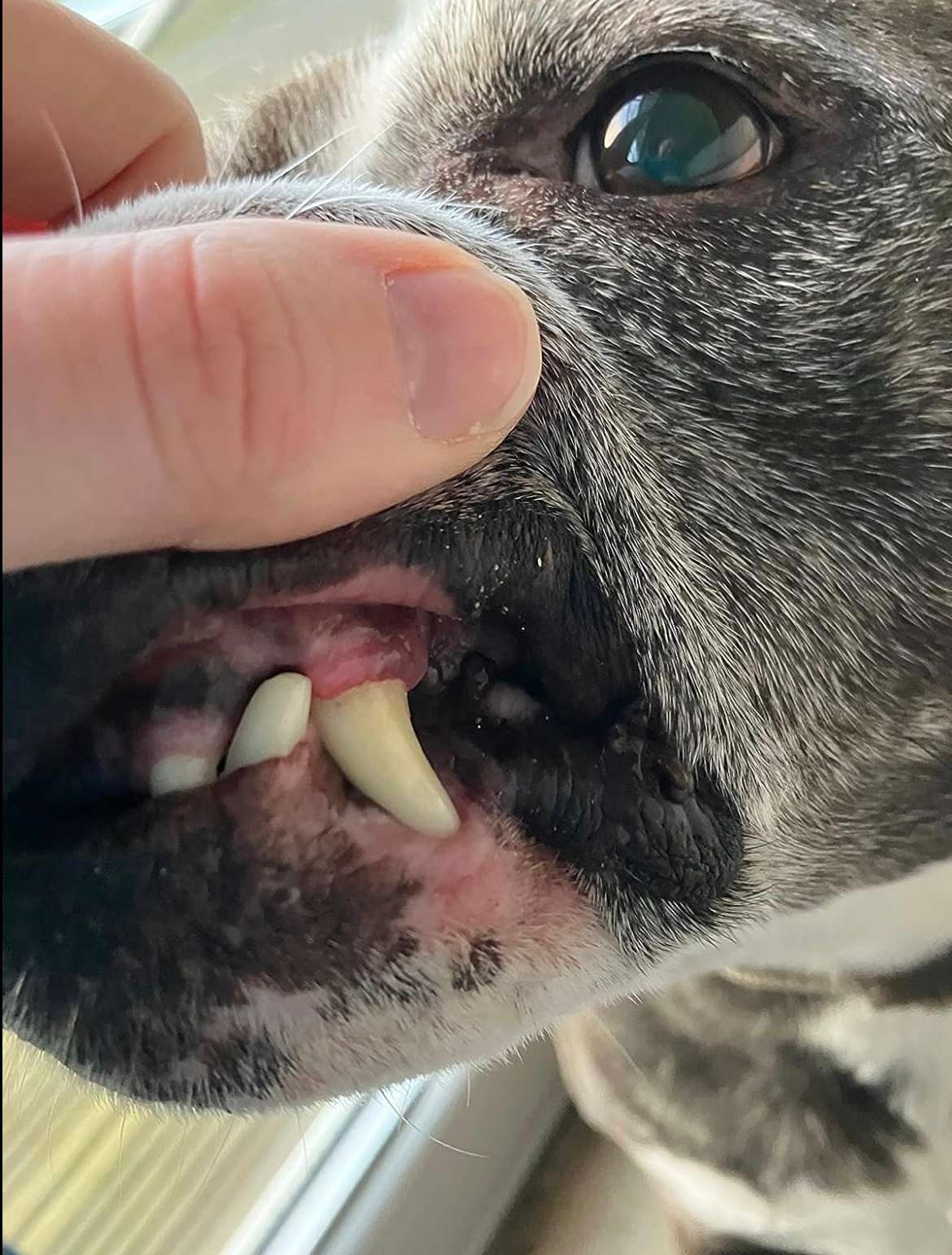
Authorized customer example. A visible change does not replace an exam or predict another dog’s result.

The plan finally made sense
- 1Professional assessment owns the diagnosis. Rosie’s age did not make internet advice a substitute for an individual veterinary conversation.
- 2Brushing owns soft-plaque control. I kept the preventive routine rather than treating one released fragment as the end of dental care.
- 3RodentLab owns a narrow surface job. Only suitable stable visible teeth, only while Rosie remained comfortable.
- 4Red flags stop the home session. Pain, movement, bleeding, swelling, damaged enamel or severe inflammation go back to the veterinarian.
- 5Photographs make follow-up clearer. Same side, similar light, same distance and a note about the session.
What “senior-friendly” should actually mean
It should not mean “skip the veterinarian because the dog is old.” It should mean the decision respects the individual dog, uses the least force necessary, stops at clear safety boundaries and avoids pretending that one product can answer every dental question.
RodentLab adds no anesthesia decision. It also cannot resolve an anesthesia decision. It is simply a non-ingestible, hands-on surface-care tool. That distinction kept the choice honest.
The record I now keep between visits
I take photographs from the same side in similar light instead of collecting random close-ups that cannot be compared. I note the tooth, date, selected level, session length and whether Rosie stayed loose enough to take a reward.
I also record what I did not do. I do not work on a surface if the tooth moves. I do not use the device to test whether an inflamed area is painful. I do not interpret a cleaner outer surface as evidence that the root and gumline are healthy.
That record gives the next veterinary conversation something more useful than “I think it looks better.” It also keeps me from turning a good result into overconfidence.
No seaweed powder, iodine, flavoring or additive placed in food or water.
A dog that can accept mouth handling and an owner who can identify and stay on a suitable hard surface.
Gradual between-visit care for visible hardened material on stable teeth.
Diagnose, image, clean beneath the gumline, extract, repair or treat infection.
Verified owners describe the same gradual approach
★★★★★“I introduced it slowly, and my dog did not mind me using it.”
Deanne · Verified buyer
★★★★★“It removed some tartar the first time and the rest took a few sessions.”
Shaune · Verified buyer
★★★★★“The safety feature and quieter-than-a-phone vibration made me feel more comfortable.”
Jason H. · Verified buyer
Use the 60 days to test suitability—not your dog’s patience
Some older dogs need more time. Some will never be good candidates for a hands-on home device. The guarantee gives you room to find that out without forcing a full-mouth session.
My next steps were simple
- 1Keep the veterinary appointment and bring clear photographs.
- 2Continue brushing where Rosie comfortably allows it.
- 3Use RodentLab only on the visible surfaces already judged suitable.
- 4Stop at the first sign that the tooth or the dog is not appropriate for home care.
A senior-dog plan should reduce confusion, not hide the limits
See the exact RodentLab kit, current price, working instructions and guarantee before deciding whether its narrow role fits your dog.
See RodentLab’s official product page